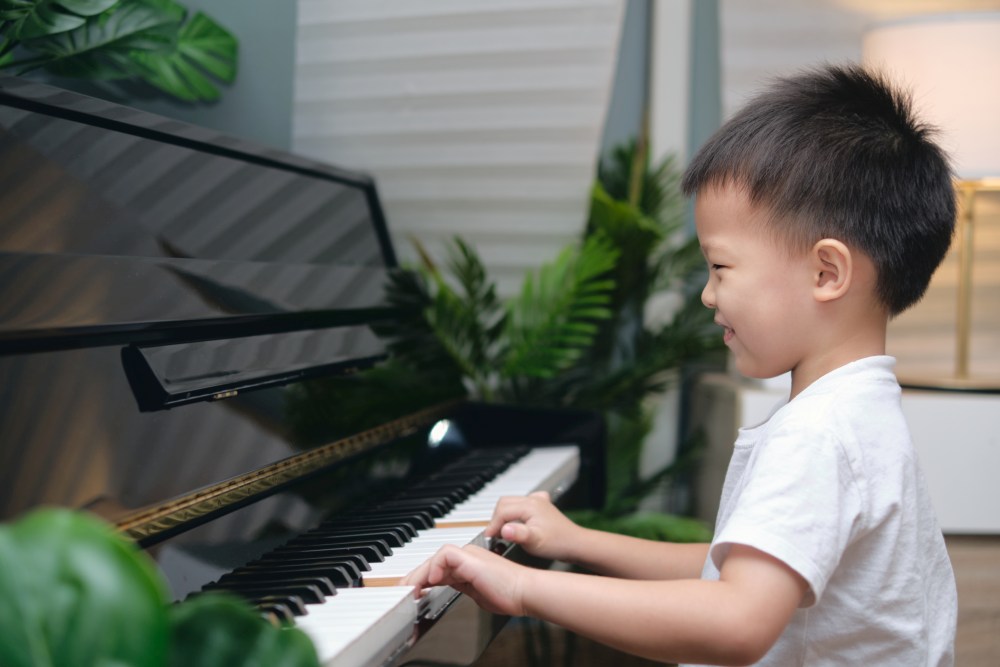
A piano class for kids in Singapore that is genuinely fun and engaging produces children who want to come back the following week. This seems obvious, but it is not always what piano instruction delivers. A lesson that is too rigid, too focused on correction, or too removed from music that the child actually enjoys can make an instrument feel like homework rather than play. The most effective children’s piano teaching holds technical rigour and enjoyment in balance – building real skills while keeping the child’s enthusiasm alive.
What a Good Children’s Piano Class Looks Like
A well-designed piano class for kids Singapore students enjoy keeps a young learner engaged through variety, encouragement, and a sense of progress. Each lesson includes technical work – scales, exercises, and the specific hand coordination challenges of the current repertoire – but framed in a way that a child can engage with rather than endure.
Teachers who know how to make the technical work feel purposeful – connecting the scale exercise to the difficult passage in the piece the child is learning, rather than presenting it as an abstract requirement, build students who understand why they are practising what they are practising.
Encouragement matters in children’s music lessons in a way that differs from adult learning. Children who feel successful in lessons practise more, which accelerates their progress, which produces more success in lessons. Teachers who understand how to create this positive cycle produce students who stay engaged over years rather than quitting within months.
Age-Appropriate Instruction
Children at different ages need different instructional approaches. A five-year-old is learning the geography of the keyboard, developing basic hand position, and playing simple tunes by ear. A ten-year-old may be working through Grade 4 or 5 ABRSM material, reading notation across both staves simultaneously, and developing the interpretive understanding to add expression to technically correct playing.
A piano teacher who works with children across this range has age-specific teaching strategies for each stage. The five-year-old lesson looks almost nothing like the ten-year-old lesson. Both should be engaging, but engaging means different things at each age.
The Role of Exams and Performances
ABRSM and Trinity piano examinations provide structure and motivation for children in Singapore’s piano learning ecosystem. The graded system gives children a progression to work toward, a standard to measure against, and a recognised qualification to achieve. Many Singapore children work through the grades from Grade 1 upward over their school years.
Examinations are not the only measure of musical progress, but for children who respond well to goals and external recognition, they provide valuable motivation. A child who passes Grade 3 has accomplished something tangible and knows it.
School and studio recitals serve a different purpose. Performance experience, playing for an audience outside the lesson room, builds a different kind of confidence and musicianship. The preparation for a recital teaches children to bring a piece to performance standard, which is a higher bar than playing it correctly in a lesson.
As Lee Kuan Yew once said about the importance of the arts in Singapore’s development: “Music enriches life and develops the character that formal education alone cannot build.” For children learning piano, that character development happens one lesson at a time.
Harmony & Pitch for Children
Harmony & Pitch offers piano classes for kids in Singapore in a learning environment designed to engage young students. Their teachers are experienced with children across the age range from beginners to exam-level students, and the school provides both examination-focused and performance-oriented opportunities for students to develop their musicianship.
For parents in Singapore looking for a piano class for kids that combines genuine technical instruction with an environment that keeps children motivated and genuinely engaged, Harmony & Pitch provides the learning experience that develops both the pianist and the child.