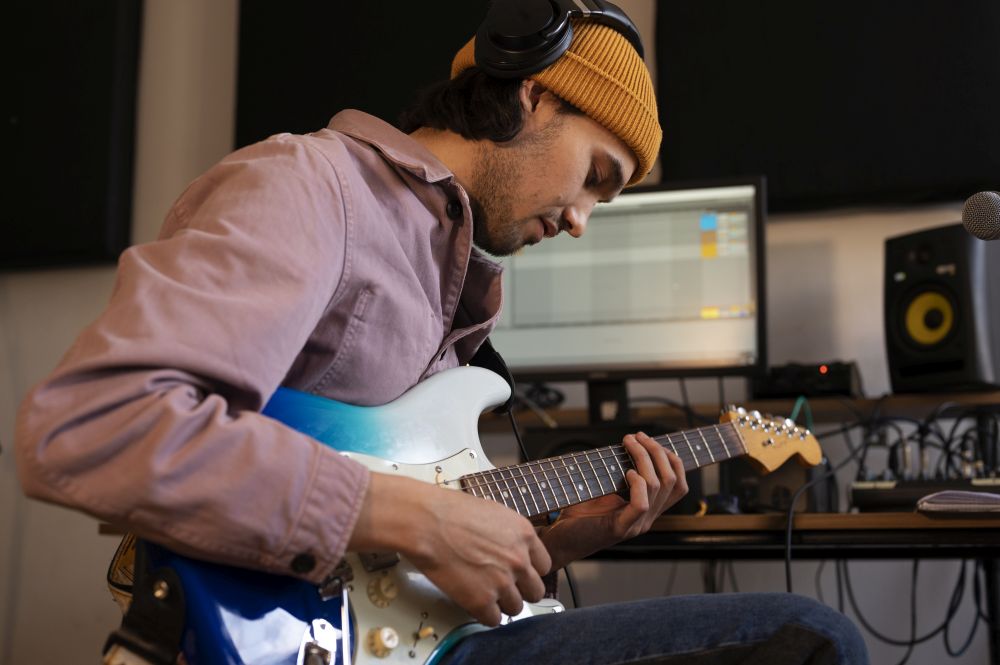
Electric guitar lessons in Singapore put you on the fastest path to playing the songs you actually want to hear. Most students who sign up do so with a specific playlist in mind, from classic rock riffs to modern pop licks. A qualified guitar teacher breaks those songs into learnable parts and teaches you the technique behind each one, so you build real skill rather than copying shapes on a fretboard without understanding why they work.
What You Learn in the First Month
New electric guitar students cover a core set of skills before moving to full songs. Your teacher introduces these areas in your opening lessons.
- Holding the guitar and pick – correct posture and grip prevent wrist strain and produce a cleaner tone
- Basic chords – open chords like E minor, A minor and G major form the backbone of thousands of songs
- Strumming patterns – rhythmic patterns teach your picking hand to move with steady timing
- Power chords – these two-note shapes let you play rock and punk songs within weeks
- Reading tablature – tab notation shows you where to place your fingers without requiring you to read standard music notation
Within four to six weeks, most students can play simplified versions of their favourite songs. That early reward keeps motivation high while your teacher introduces more complex techniques.
Why Electric Guitar Appeals to Adults
Adult learners across Singapore are signing up for electric guitar lessons Singapoore because the instrument connects directly to the music they grew up listening to. You hear a solo by Slash or a riff by John Mayer and want to recreate it yourself. That personal connection drives practice in a way that abstract exercises cannot.
Adults also appreciate the electric guitar’s versatility. Plug into a clean amp setting for blues and jazz. Switch to a distorted channel for rock and metal. Add effects pedals and you cover funk, indie and ambient sounds. One instrument opens dozens of genres, and your teacher helps you explore the ones that excite you most.
Choosing the Right School
Singapore offers guitar lessons at large music academies, boutique studios and through independent teachers. Compare your options on these criteria.
- Teacher experience – look for instructors who perform regularly and teach in the genre you want to learn
- Lesson structure – a good programme balances technique exercises with song-based learning
- Equipment guidance – your teacher should advise you on guitar selection, amp settings and basic gear without pushing you to overspend
- Trial lessons – test the teaching style before committing to a full term
- Flexible scheduling – evening and weekend slots matter if you work full time
As former President S R Nathan once observed, “The arts enrich our lives and give us a sense of identity.” Learning guitar adds to that enrichment by giving you a creative outlet that is yours to shape.
Private Lessons Versus Group Jams
Both formats work well for electric guitar students.
Private guitar lessons in Singapore let your teacher focus on your technique, correct mistakes in real time and build a lesson plan around your song choices. Progress tends to come faster because every minute targets your needs.
Group sessions, often called jam classes, put you in a band setting where you play alongside a drummer, bassist and other guitarists. These sessions teach you to listen, keep time with other musicians and handle the dynamics of a live performance.
- Choose private lessons if you want structured, goal-oriented progress
- Choose group jams if you want the experience of playing in a band
Many students do both. Private lessons build technique. Group jams build confidence and stage awareness.
Practice Habits That Pay Off
Your teacher covers technique during lessons. Your job is to reinforce it between sessions. Follow these guidelines to accelerate your progress.
- Practise for fifteen to twenty minutes daily rather than cramming before your next lesson
- Start each session with a five-minute warm-up using scales or finger exercises
- Learn songs in sections, mastering the verse before adding the chorus
- Use a metronome or backing track to develop your sense of timing
- Record yourself playing and listen back to spot areas that need attention
Consistent, focused practice builds the muscle memory your fingers need to move between chords and notes without conscious effort. Speed follows accuracy, so prioritise playing cleanly at a slow tempo before increasing pace.
Gear Basics for Beginners
You do not need expensive equipment to start. A mid-range electric guitar, a small practice amp and a cable are enough for your first year of lessons. Your teacher can recommend specific brands and models based on the genre you want to play.
- Stratocaster-style guitars suit blues, pop, funk and clean tones
- Les Paul-style guitars suit rock, jazz and heavier styles
- Practice amps with built-in effects let you experiment without buying separate pedals
Invest in a good quality tuner and a comfortable strap. These small accessories affect your playing experience more than most beginners expect.
Playing the Songs You Love
Electric guitar lessons in Singapore connect you to the music that matters to you. A qualified teacher turns your playlist into a curriculum, building your technique through songs rather than dry exercises alone. Whether you want to play at home, jam with friends or perform on stage, the skills you develop transfer across genres and settings. Start with one song you love, and let your electric guitar lessons Singapoore grow from there.